01Literature as a Civic Act
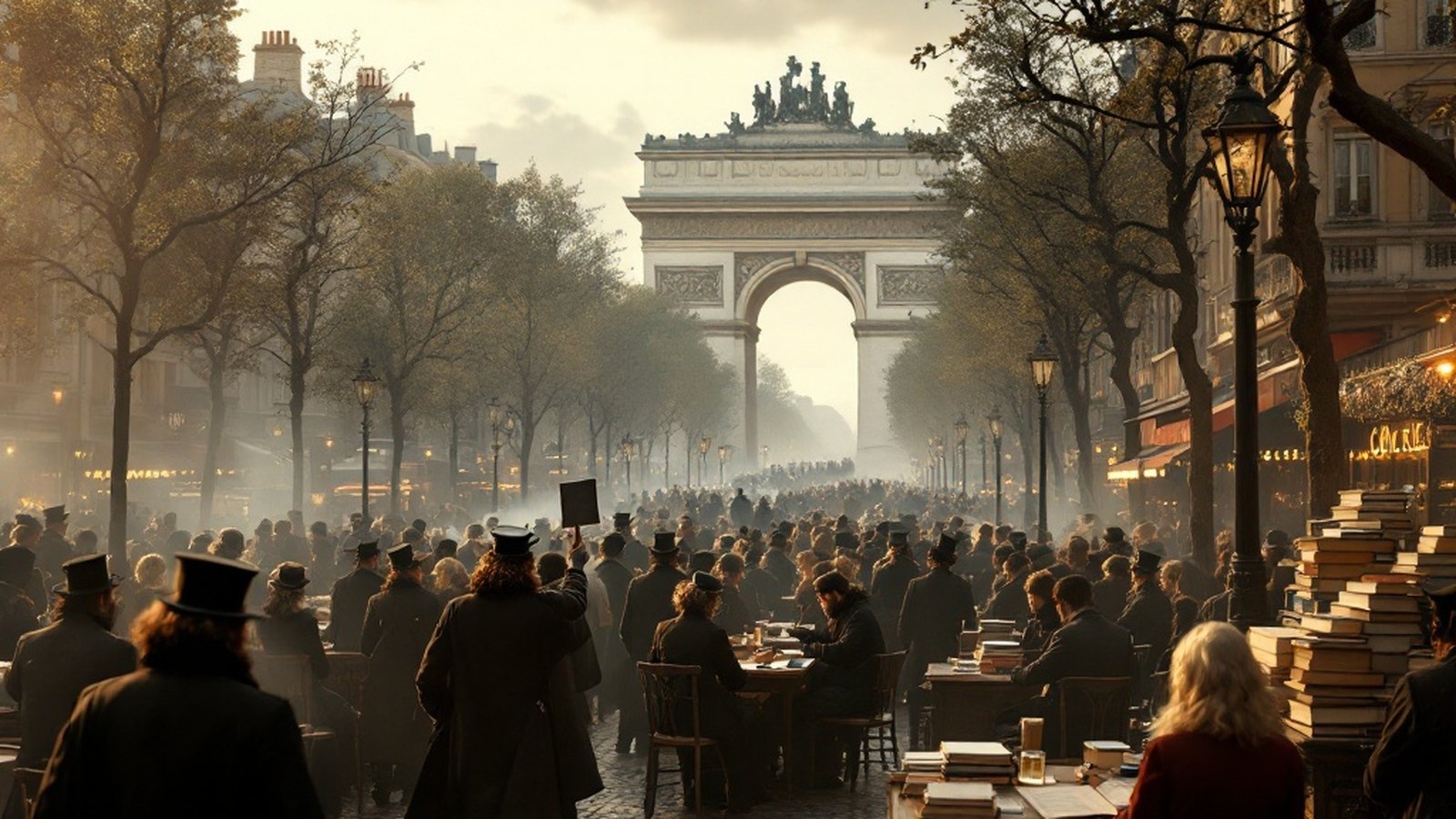
France is perhaps the only country where a novelist's death can stop traffic. When Victor Hugo died in May 1885, more than a million people lined the streets of Paris to watch his coffin pass — a state occasion for a man who commanded no army and governed nothing. The procession from the Arc de Triomphe to the Panthéon was not merely a farewell; it was an assertion of national identity. France was saying, in public, in the streets, with its feet: this is what we value.
That instinct has not disappeared. It has institutionalised itself. The French writer inhabits a peculiar position in public life — somewhere between intellectual, moralist and secular saint — that has no real equivalent in Britain or America. Authors appear on prime-time television not to promote thrillers but to argue about ideas. When a major novelist publishes, the newspapers give the book serious column inches. The question qu'est-ce que vous lisez? still carries social weight. Reading, in France, is not quite a private pleasure; it is a form of citizenship.
02The Rentrée and the Republic of Letters
The mechanism that keeps this culture visible and combustible is the rentrée littéraire — that concentrated autumn season, beginning in late August, when French publishers release the bulk of their year's fiction in a matter of weeks. The number of new novels published in a typical rentrée routinely exceeds five hundred, an extraordinary figure for any market, and the event generates a media frenzy unlike anything seen in comparable Anglophone publishing seasons. Prizes — the Prix Goncourt, the Prix Renaudot, the Prix Médicis, the Prix Femina — arrive in rapid succession through October and November, each jury deliberating in a storied Parisian restaurant or institution, each announcement treated as genuine news.

The Goncourt, awarded since 1903 by the Académie Goncourt, is the most coveted. Its monetary value is almost comically small — ten euros — but the sales surge a Goncourt win delivers is enormous, routinely propelling a title into hundreds of thousands of copies sold. The prize's true currency is prestige, which in France remains a serious commodity. Winners from Patrick Modiano to Marcel Proust have found their reputations permanently shaped by it.
Beneath the prizes runs a deeper infrastructure: literary supplements in Le Monde and Le Figaro, radio programmes where authors debate each other with philosophical seriousness, independent bookshops (librairies) that receive state support and are protected, by the Lang Law of 1981, from discount pricing that would otherwise flatten them. The fixed book price — le prix unique du livre — is itself a political statement: books are not like other commodities. They require different treatment.
03The Panthéon and the Writer as Monument
The French have a habit of literally enshrining their writers. The Panthéon, that great neoclassical dome on the Left Bank, was repurposed during the Revolution as a secular mausoleum for the nation's great figures. Voltaire was among the first transferred there, in 1791, followed by Rousseau in 1794, and the gesture was entirely deliberate: France was declaring that its Enlightenment writers were its founding fathers as surely as any general or statesman. Hugo followed in 1885. Émile Zola was transferred in 1908. More recently, Simone Veil — politician, but also memoirist and one of the twentieth century's great witnesses — was interred there in 2018. The building is a kind of argument, made in stone, about who a republic honours.
The French have a habit of literally enshrining their writers.
This veneration has living consequences. France funds its writers through organisations such as the Centre national du livre, which supports translation, publication and residencies. The Académie française, that forty-seat institution founded in 1635 by Cardinal Richelieu, still deliberates over the French language with an authority that would strike most outsiders as theatrical but which the French take with genuine seriousness. Literary feuds make headlines. A novelist's political opinions are solicited, printed and contested in ways that would seem strange in countries where writers are expected to stay in their lane.
04The Tradition That Makes It Possible
None of this arrives from nowhere. French literature has, for several centuries, identified the written word with the examined life — Montaigne turning his Essais into an investigation of what it means to be human; the moralists of the seventeenth century compressing whole philosophies into a sentence; the Enlightenment philosophes insisting that ideas on a page could reorganise society. When Zola published J'accuse…! in 1898, it was a newspaper article, but its force derived from the cultural authority of the novelist who signed it. France had been trained, for generations, to believe that the writer speaks not merely for himself but for something larger.
That tradition sustains a reading public that remains, by any measure, serious. French readers argue about form and style, about whether a novel's sentences are beautiful, about the difference between a writer who merely tells a story and one who makes literature. Those are not mass-market questions — and yet in France they are asked in mass-market newspapers, in lycée classrooms, on the radio on a Tuesday afternoon.
The writer, in France, is never quite off duty. And France, reading, is never quite off duty either.