
01The Machine of Involuntary Memory
The scene is so famous it has become a cultural shorthand: a man dips a small cake — a madeleine — into a cup of lime-blossom tea, and something impossible happens. The present dissolves. The taste summons not a memory but the thing itself: the village of Combray, the Sunday mornings, the whole geography of a childhood, intact and luminous. It is the founding moment of À la recherche du temps perdu, and Proust earns it. The madeleine passage arrives only after pages of the narrator lying in the dark, unable to remember Combray except as a flat, willed image — the dead residue that voluntary memory can produce. When the taste hits, what returns is different in kind: not recollection but resurrection.
Proust named this mechanism mémoire involontaire, and it is the novel's engine. Involuntary memory, triggered by sensation rather than intention, delivers experience with an emotional fullness that deliberate recall cannot achieve. The great claim of La Recherche — running across seven volumes, from Du côté de chez Swann in 1913 to Le Temps retrouvé, published posthumously in 1927 — is that this mechanism can be made the basis of an entire art. Sensation recaptured through time becomes something more than sensation: it becomes meaning.
The novel is immense. At somewhere in the region of 1.5 million words, it holds a plausible claim to the longest single novel in any language. It is also, sentence by sentence, one of the most controlled. Proust worked the way a composer revises a score: the famous long sentences spiral outward through subordinate clauses, hedging and qualifying and then suddenly arriving at an image of startling clarity. What seems like digression is nearly always return. A sentence that opens on an observation about snobbery or jealousy will circle, by the time the full stop arrives, back to its original subject — but changed, as the narrator himself will be changed by the end.
02The World He Made
Proust was born in Paris in 1871, into a comfortable bourgeois family with access to the Parisian social world he would spend a lifetime dissecting. His mother, Jeanne Weil, came from a cultivated Jewish family; his father, Adrien Proust, was a distinguished physician. Marcel was sickly from childhood — asthma shaped his life and eventually confined the writing of La Recherche to a cork-lined bedroom in the Boulevard Haussmann, then later the rue Hamelin — but he was also social, witty and intensely observant. He attended the salons of the Faubourg Saint-Germain, knew painters and musicians, and translated Ruskin before beginning the great work in earnest.
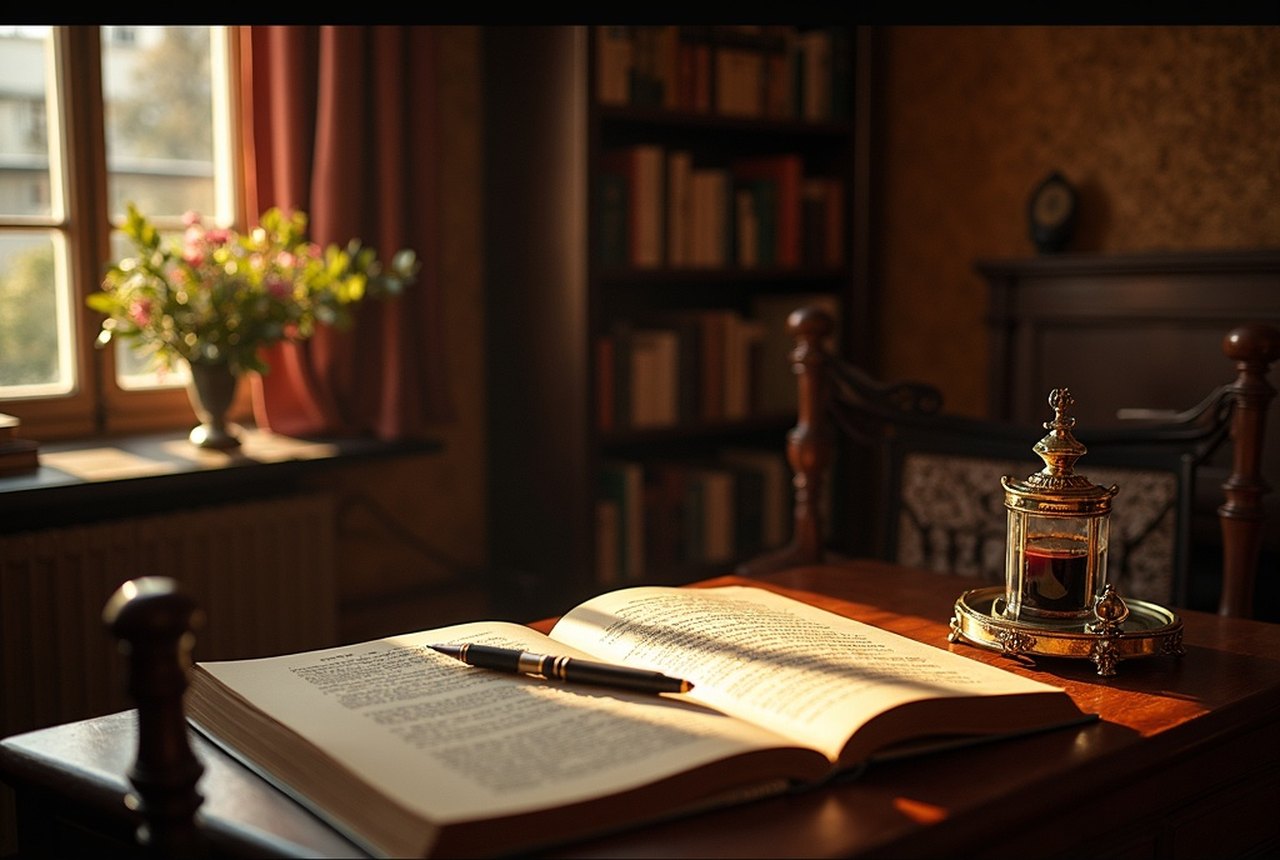
The social world of La Recherche is drawn from life with a fictionist's freedom. The aristocratic Guermantes family, the Jewish intellectual Swann, the predatory social climber Madame Verdurin — these figures have real-world originals, partially, but they exceed them. Proust was interested less in individuals than in the forces that move through individuals: snobbery, jealousy, desire, the cruelty of time. The Dreyfus Affair, which divided France viciously in the years before the novel opens, passes through the social world of La Recherche like a geological fault line, revealing character and class with geological patience.
The narrator — known famously but indirectly as Marcel, the name appearing only twice and obliquely — is not exactly Proust, but the gap between them is narrow and productive. He is a writer who cannot write, an artist who spends volume after volume in society, in love, in illness, deferring the work he knows he must do. The last volume, Le Temps retrouvé, resolves the deferral. At a party, grown old, the narrator stumbles on a series of involuntary memories and understands at last what they mean and what they demand. The novel he must write is the novel we have just finished reading. The structure folds back on itself with a satisfaction that is genuinely architectural — Proust had the ending in mind almost from the beginning.
Translation has served Proust remarkably well in English. C. K. Scott Moncrieff began his version, which he called Remembrance of Things Past, in 1922; the final volume was completed after his death by others and later revised by Terence Kilmartin and then D. J. Enright. In 2002, Penguin issued a fresh complete translation under the more literal title In Search of Lost Time, with different translators taking each volume. Both traditions are alive and debated by readers who care about the colour of the prose as much as the sense — which, for Proust, is perhaps as it should be.
The novel's reputation can make it feel like an obligation. It is not. It is a pleasure that deepens on re-reading, a book about time that rewards time given to it. Proust argued that art alone recovers the past in its full reality — not as it was, exactly, but as it was felt, which is the only version that matters. Whether or not one accepts the metaphysics, the prose makes the case. Taste the tea. Wait.
The social world of La Recherche is drawn from life with a fictionist's freedom.