01Automatism and the Unleashed Sentence
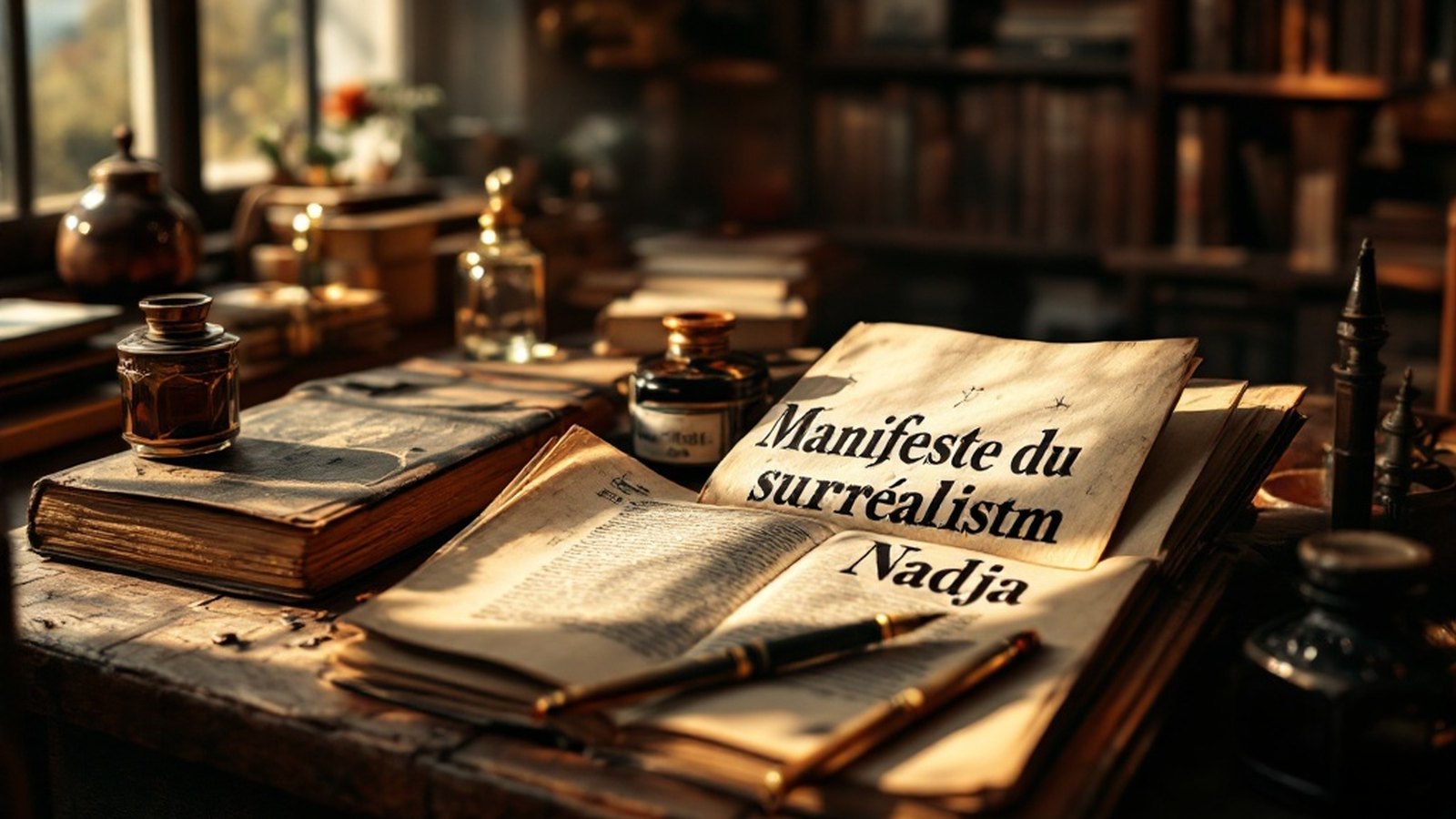
In 1924, André Breton published his Manifeste du surréalisme and gave French letters one of its most audacious redefinitions. Poetry, he declared, was not to be crafted: it was to be seized. The imagination, freed from reason's jurisdiction, would produce something he called le merveilleux — the marvellous — a quality that trembled at the edge of dream and waking, where the most violent and beautiful images rose unbidden. The movement that followed was chaotic, contentious, politically entangled, and brilliantly fertile. It changed what a French sentence could be asked to do.
The core technical bet was écriture automatique — automatic writing. Breton and Philippe Soupault demonstrated its first sustained result in Les Champs magnétiques (1920), composed before the manifesto gave it its name: passages written at speed, without revision, without the rational mind's editorial interference. The method borrowed loosely from Freud's notion of the unconscious, though the Surrealists cheerfully misread Freud as permission rather than diagnosis. What mattered was velocity and surrender. Write faster than you can think, and something underneath thinking will speak.
Reading Les Champs magnétiques now, you feel the experiment's double nature — passages of raw, lurching beauty alongside passages of plain chaos. The interest is partly forensic, partly genuine. But the project mattered enormously as proposition: it insisted that the poem's job was not to communicate clearly but to transmit — to carry an electric charge from one unconscious to another. Clarity, the old French cardinal virtue, was not merely demoted; it was named the enemy.
02The Images They Threw Up
What automatism actually produced, at its best, was an unprecedented density of image. Breton's own prose poems in Clair de terre and L'Amour fou move by association rather than argument, yoking together phenomena that daylight keeps apart. His definition of the surrealist image — borrowed partly from Pierre Reverdy — held that the power of an image depended on the distance between its two terms. Far-flung comparisons, unlikely conjunctions: a woman's hair described in the vocabulary of weather, a city read as a body, desire mapped onto landscape. These were not decorative metaphors but structural ones, the poem's entire load-bearing logic.
Paul Éluard carried this into a more lyrical register. His collections — Capitale de la douleur, L'Amour la poésie — move with a lightness that makes the images feel inevitable rather than calculated, and translation into English has rarely captured the exact tremor of that lightness. Benjamin Péret went further into systematic derangement, his poems deliberately offensive to common sense in ways that still feel abrasive. Robert Desnos worked the territory between automatic speech and song; his prose is among the most seductive the movement produced. Louis Aragon, before his long detour into committed realism, wrote Le Paysan de Paris — a prose poem wandering the Passage de l'Opéra — in which the marvellous is found not in dreams but in the city's concrete arcades, its shop fronts and gas lamps transfigured by sustained attention.
Breton himself was always more theorist than pure maker. His manifestoes, Les Vases communicants, Nadja — that strange hybrid of memoir, love story and urban mysticism — are the works that last, and they last partly because the ideas are doing as much work as the language. Nadja in particular remains genuinely unsettling: a real woman, Léona Delcourt, transformed by the narrator's gaze into a figure of the marvellous, a living surrealist object. The book's ethics make later readers uneasy. Its spell holds anyway.
03What Stayed in the Air
The movement fractured across the 1930s — expelled members, Communist Party allegiances, competing manifestoes, wartime exile to New York. By 1945 Surrealism as a collective enterprise was largely over, though Breton went on issuing pronouncements until his death in 1966. But its residue in French writing is everywhere and lasting.
What automatism actually produced, at its best, was an unprecedented density of image.
The permission to trust the image over the argument, to let syntax stretch toward dream-logic, to pursue le merveilleux as a serious literary aim rather than an escapist one — all of this entered the bloodstream. You hear it in Henri Michaux's inner-world voyages, in René Char's compressed, hermetic lyrics, in the way French prose poetry, even in its quieter contemporary forms, remains comfortable with leaps that Anglo-American writing still treats as eccentric.
What the Surrealists understood, at their most lucid, was that the marvellous is not the opposite of the real: it is the real world seen under sufficient pressure, until it gives up the strangeness it ordinarily conceals.