01The Flowers That Scandalised
When Les Fleurs du mal appeared in 1857, French justice moved fast. Baudelaire and his publisher were prosecuted for offending public morals; six poems were ordered suppressed. The irony is exquisite: the trial made the book immortal. What the court heard as obscenity, later readers recognised as precision — an unflinching attention to the body, the city, the seductive beauty coiled inside corruption and decay.
Baudelaire had been assembling the collection for years, and its architecture is deliberate: the great opening cycle "Spleen et idéal" pits aspiration against suffocation, the ideal against a crushing ennui the poet made peculiarly his own. Spleen — a word he borrowed from English and made French — names a condition beyond mere sadness: a paralysis of the spirit, cold and grey as a Parisian November, against which beauty must be violently seized.
02The Flâneur and the Street
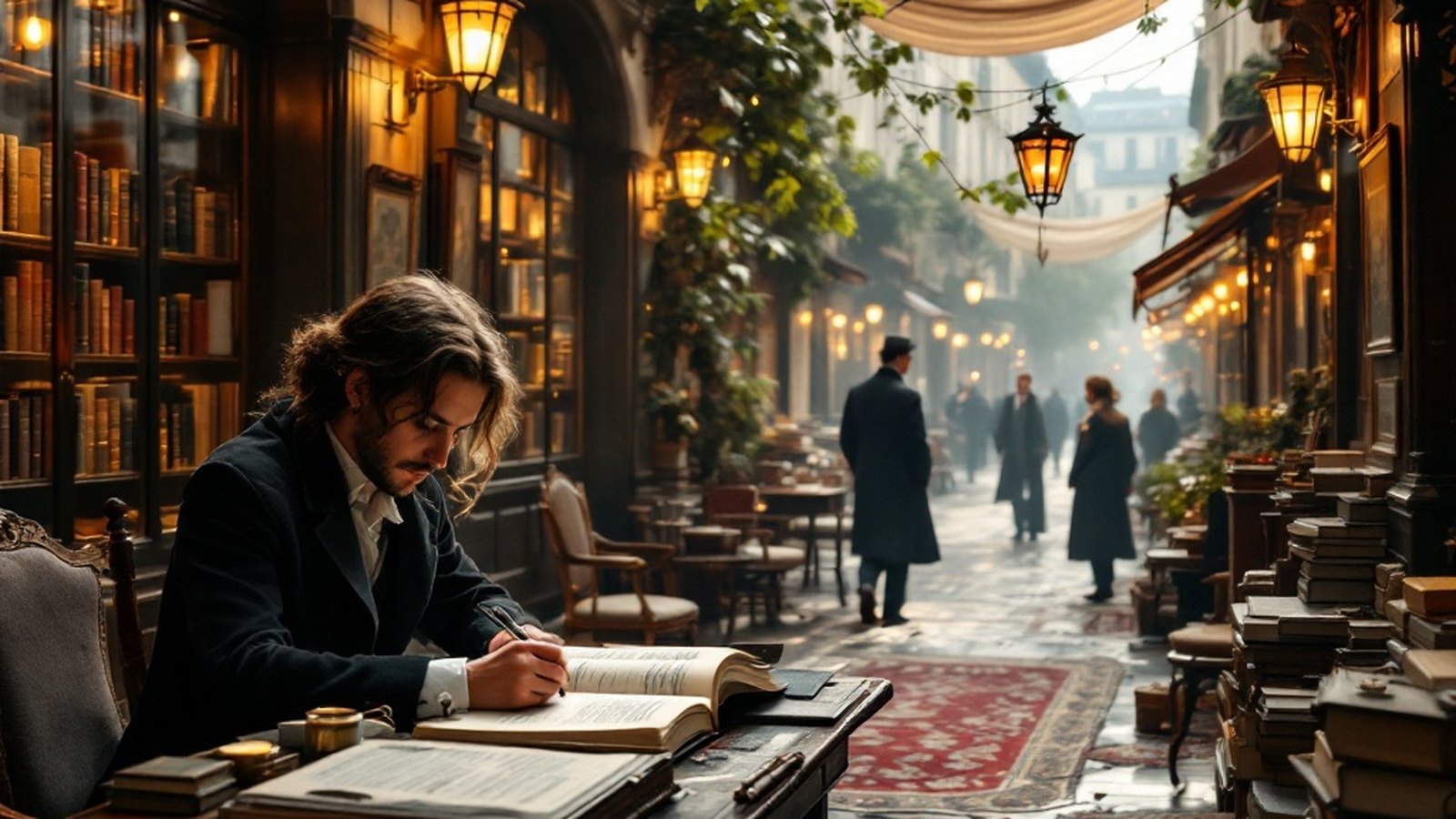
No poet before Baudelaire had looked so steadily at the modern city. He moved through Haussmann's convulsive Paris as what he himself called the flâneur — the detached, observant stroller who feeds on the spectacle of strangers, crowds, gaslit arcades. In his prose poems, collected as Le Spleen de Paris and published posthumously, the street is not backdrop but subject: a widow on a bench, a juggler at dusk, a beggar. Ugliness is not avoided; it is transfigured. Baudelaire's definition of modernity, set out in his remarkable essay on the painter Constantin Guys, is a gift to every art that followed: the beautiful is composed half of the eternal, half of the transient and fugitive — and it is the second half that makes the first legible.
That idea cracked poetry open. After Baudelaire, the Symbolists — Verlaine, Mallarmé, Rimbaud — found their licence in his example. Rimbaud in particular pushed the door Baudelaire had forced. The concept of the correspondances, Baudelaire's sense that the senses answer one another and that poetry can orchestrate their resonance, runs forward through an entire tradition of French verse and beyond it into the novel, into music, into film.
Les Fleurs du mal never stopped being read. The condemned poems were not legally restored in France until 1949. The book had shaped world literature for nearly a century before its author was fully acquitted. That gap tells you something essential about Baudelaire: he was always ahead of the verdict.
No poet before Baudelaire had looked so steadily at the modern city.